
Animal Kingdom Classification: 11 Phyla Chart
Quick answer: The animal kingdom classification chart divides Kingdom Animalia into 11 major phyla, from Porifera to Chordata, on five body-plan features: level of organisation, symmetry, germ layers, coelom and segmentation. Animals are multicellular, eukaryotic heterotrophs without cell walls. Arthropods dominate: about 80% of all known species belong to that single phylum.
Key Facts: Animal Kingdom Classification
- Kingdom Animalia holds about 1.5 million described species, sorted into 11 major phyla arranged from the simplest (Porifera) to the most complex (Chordata).
- The five bases of classification are: level of organisation, body symmetry, germ layers, body cavity (coelom) and segmentation.
- About 99% of animal species are invertebrates; Arthropoda alone holds about 80% of all known species, and Mollusca is the second-largest phylum.
- Sponges are built at the cellular level and lack true tissues; true tissues first appear in Cnidaria, and the true coelom first appears in Annelida.
- All chordates share four characters — notochord, dorsal hollow nerve cord, pharyngeal slits and post-anal tail — present at least during the embryonic stage.
- Older textbooks list "Aschelminthes" as the fifth phylum; modern taxonomy treats it as an obsolete, polyphyletic grouping and uses Phylum Nematoda instead.
These notes are a complete animal kingdom classification chart: all 11 phyla, from sponges to chordates, in a single master table with examples, body plans and the five features defining each phylum. The table follows the traditional textbook sequence, with one modern correction — the outdated grouping Aschelminthes is replaced by Phylum Nematoda. Study the five bases first, then read the master table column by column.


Why Do Biologists Classify the Animal Kingdom?
More than 1.5 million animal species have been described, and millions more await discovery. Without a classification chart this diversity is unmanageable: classification groups animals by shared body-plan features, reveals evolutionary relationships, and lets a reader predict the biology of an unfamiliar animal from its phylum alone.
Aristotle made the first great cut, separating animals with blood from those without — the ancient forerunner of the invertebrate–vertebrate divide. The modern scheme reads the body itself, using comparative anatomy and embryology to sort every animal, from flatworm to blue whale, into one of 11 phyla.
The Five Bases of Animal Kingdom Classification
Kingdom Animalia is divided into phyla on five fundamental body-plan features. Learn them as a closed set: every row of the master chart is read through these five, and the five-feature signature fixes any animal in its phylum — level of organisation, body symmetry, germ layers, coelom and segmentation:
- Level of organisation — how cells are arranged:
- Cellular: loose aggregates, no true tissues (Porifera)
- Tissue: tissues but no organs (Cnidaria, Ctenophora)
- Organ: organs but no systems (Platyhelminthes)
- Organ-system: coordinated organ systems (Nematoda onward)
- Body symmetry — how parts repeat: asymmetrical (sponges) → radial (Cnidaria; adult Echinodermata) → biradial (Ctenophora) → bilateral (all higher phyla)
- Germ layers — embryonic cell layers:
- Diploblastic: ectoderm + endoderm (Cnidaria, Ctenophora)
- Triploblastic: adds mesoderm (Platyhelminthes onward)
- Body cavity (coelom) — cavity between body wall and gut:
- Absent / acoelomate (Porifera through Platyhelminthes)
- Pseudocoelomate: false cavity, not fully mesoderm-lined (Nematoda)
- Coelomate: true mesoderm-lined cavity (Annelida onward; reduced in Arthropoda, Mollusca)
- Segmentation — absent in most phyla; metameric in Annelida, Arthropoda and Chordata
Read the summary table as taxonomists read an animal: work down the rows and note where each new grade of organisation appears, from loose cell aggregates toward fully integrated organ systems.
| Basis of Classification | Meaning | Categories |
|---|---|---|
| Levels of organisation | How cells are arranged in the body | Cellular (Porifera) → Tissue (Cnidaria, Ctenophora) → Organ (Platyhelminthes) → Organ-system (rest) |
| Body symmetry | How body parts repeat around the body | Asymmetrical (sponges) → Radial (Cnidaria, adult Echinodermata) → Bilateral (all advanced phyla) |
| Germ layers | Number of embryonic cell layers | Diploblastic (Cnidaria, Ctenophora) vs Triploblastic (Platyhelminthes onward) |
| Body cavity (coelom) | Cavity between body wall and gut, lined by mesoderm | Acoelomate → Pseudocoelomate (Nematoda) → Coelomate (true coelom from Annelida onward) |
| Segmentation | Body divided into repeated segments | Present in Annelida, Arthropoda, Chordata; absent in most others |
Classification of Animal Kingdom Chart: All 11 Phyla
This is the master table: read each row left to right — phylum, organisation, symmetry, germ layers, coelom, distinctive feature, example. Every animal you will ever meet belongs in one of these rows.
| Phylum | Organisation | Symmetry | Germ Layers | Coelom | Distinctive Feature | Example |
|---|---|---|---|---|---|---|
| Porifera | Cellular | Asymmetrical | — | Absent | Pore-bearing body, canal system, choanocytes | Sycon, Spongilla, Euplectella |
| Cnidaria | Tissue | Radial | Diploblastic | Absent | Cnidocytes (stinging cells); polyp and medusa forms | Hydra, Aurelia, Adamsia |
| Ctenophora | Tissue | Biradial | Diploblastic | Absent | Eight comb plates (ctenes) for swimming | Pleurobrachia, Ctenoplana |
| Platyhelminthes | Organ | Bilateral | Triploblastic | Acoelomate | Flat body, flame cells, mostly parasitic | Taenia, Fasciola, Planaria |
| Nematoda | Organ-system | Bilateral | Triploblastic | Pseudocoelomate | Cylindrical unsegmented body with a tough cuticle | Ascaris, Wuchereria, Ancylostoma |
| Annelida | Organ-system | Bilateral | Triploblastic | Coelomate | True metameric segmentation, nephridia, setae | Earthworm, Nereis, Leech |
| Arthropoda | Organ-system | Bilateral | Triploblastic | Coelomate (reduced) | Jointed appendages, chitinous exoskeleton | Cockroach, Butterfly, Prawn |
| Mollusca | Organ-system | Bilateral | Triploblastic | Coelomate (reduced) | Soft body with mantle, muscular foot, radula in most | Pila, Unio, Octopus |
| Echinodermata | Organ-system | Radial (adult) | Triploblastic | Coelomate | Water vascular system with tube feet; spiny skin | Starfish, Sea urchin, Holothuria |
| Hemichordata | Organ-system | Bilateral | Triploblastic | Coelomate | Proboscis, collar and trunk; marine worms | Balanoglossus, Saccoglossus |
| Chordata | Organ-system | Bilateral | Triploblastic | Coelomate | Notochord, dorsal nerve cord, pharyngeal slits, post-anal tail | Fish, Frog, Bird, Human |
A note on the fifth row: older textbooks print "Aschelminthes" here — now an obsolete, polyphyletic grouping whose former members, including roundworms, became phyla in their own right. Modern charts use Phylum Nematoda.
Worked Example: Placing an Animal in the Classification Chart
Take the earthworm: organ-system organisation, bilateral symmetry, triploblastic germ layers, a true coelom and metameric segmentation. That five-feature signature is unique to Annelida — the first phylum where a true body cavity appears. Try a cockroach (jointed appendages, chitinous exoskeleton, reduced coelom → Arthropoda) and a starfish (radial adult, water vascular system → Echinodermata) the same way.
The Evolutionary Sequence of the Phyla
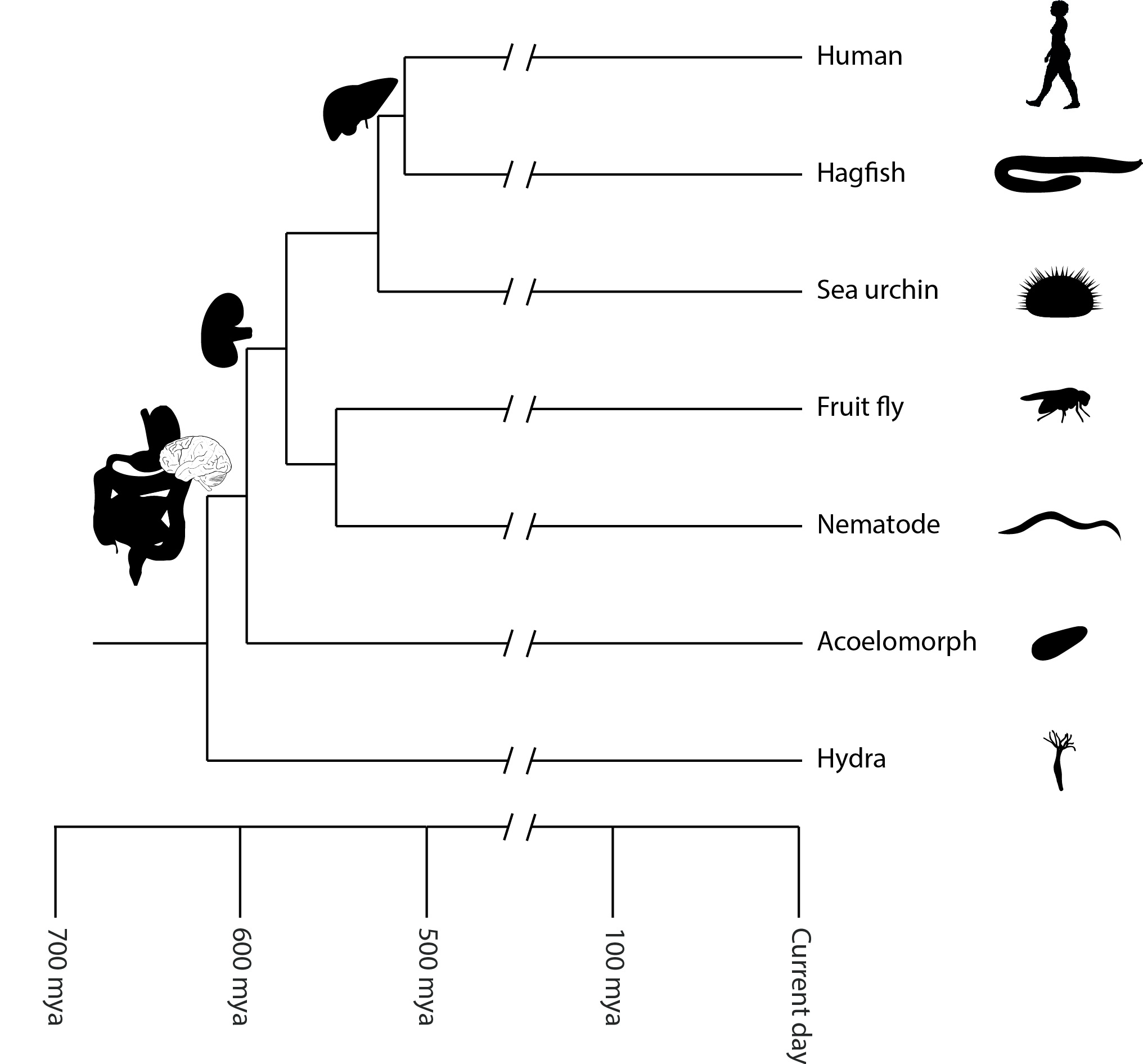

The phyla follow the traditional textbook order, from simpler to more complex body plans — but this is not a true evolutionary lineage, and modern phylogenies rearrange several branches. Treat it as a ladder of grades, not a family tree. One memory sentence makes the sequence stick: "Please Come Chat; Peter Never Ate Apple Mango; Every Hungry Child" — Porifera, Cnidaria, Ctenophora, Platyhelminthes, Nematoda, Annelida, Arthropoda, Mollusca, Echinodermata, Hemichordata, Chordata.
Moving down the chart, organisation rises from cellular to organ-system, symmetry settles on bilateral, a third germ layer appears, and the coelom emerges as a true cavity. Echinodermata is the famous exception: its adults returned to radial symmetry secondarily, though larvae are bilateral, because the water vascular system's tube feet work best with no fixed front end.
Vertebrates vs Invertebrates in the Animal Kingdom: Quick Comparison
The oldest split in the chart is the simplest: backbone or no backbone. Invertebrates lack a vertebral column and span ten of the eleven phyla — from sponges to insects — making up about 99% of animal species. Vertebrates develop a notochord replaced by a vertebral column, and form just one subphylum (Vertebrata) of Chordata: fishes, amphibians, reptiles, birds and mammals, from egg-laying monotremes to placental mammals.
| Feature | Invertebrates | Vertebrates |
|---|---|---|
| Backbone | Absent | Present (vertebral column) |
| Phyla included | All phyla except Chordata (10 phyla) | Subphylum Vertebrata of Chordata only |
| Share of species | About 99% of animal species | About 1% of animal species |
| Notochord | Absent | Present in embryo; replaced by vertebral column |
| Examples | Earthworm, Butterfly, Snail, Starfish | Fish, Frog, Snake, Bird, Human |
Strictly, not every chordate is a vertebrate: lancelets and tunicates are invertebrate chordates that never develop a backbone. The "ten phyla plus Chordata" split is a convenient simplification — but it remains the most useful first cut through the chart.
How Are Animals Different from Plants?
Kingdom Animalia is defined by characters separating animals from plants and other kingdoms: animals are multicellular eukaryotes lacking chlorophyll and cell walls; they feed heterotrophically; most move at some life stage; and they usually reproduce sexually. No plant does all of these: plants photosynthesise, build cellulose walls and stay fixed in place. These shared characters unite the whole chart, from sponges to chordates.
Conclusion: Reading the Animal Kingdom Classification Chart with Confidence
The chart compresses 1.5 million described species into eleven orderly phyla. Remember three things: the five bases (organisation, symmetry, germ layers, coelom, segmentation); the 11 phyla in order, Porifera to Chordata; and the three great divide-lines — true tissues appear with Cnidaria, the true coelom with Annelida, the backbone only in Chordata.
Practise by picking any familiar animal — a tapeworm, an earthworm, a cockroach, a starfish — and reading its five-feature signature off the master table until the placement feels automatic. That single skill underlies every later chapter of animal diversity.
Frequently Asked Questions
What are the 11 phyla of the animal kingdom?
The 11 phyla are Porifera, Cnidaria, Ctenophora, Platyhelminthes, Nematoda, Annelida, Arthropoda, Mollusca, Echinodermata, Hemichordata and Chordata, arranged in the traditional textbook sequence from simpler to more complex body plans. Older books print "Aschelminthes" as the fifth phylum; modern taxonomy replaces it with Nematoda.
What are the five bases of animal classification?
Animals are classified on the basis of: (1) level of organisation, (2) body symmetry, (3) number of germ layers, (4) body cavity or coelom, and (5) segmentation. Every phylum row in the classification chart is read through these five features.
Which is the largest phylum of the animal kingdom?
Arthropoda is the largest phylum, containing about 80% of all known animal species — insects, crustaceans, spiders and myriapods. Mollusca is the second-largest phylum. Chordata, despite feeling familiar, holds only about 1% of animal species.
Why are echinoderms grouped near chordates in the chart?
Echinoderms and chordates are both deuterostomes: the blastopore becomes the anus during development, and cleavage is radial with indeterminate embryonic cells. These shared developmental characters point to a common ancestor, even though adult starfish look nothing like vertebrates.
What is the difference between invertebrates and vertebrates?
Invertebrates lack a backbone and make up about 99% of animal species, spanning ten of the eleven phyla. Vertebrates possess a notochord that is replaced by a vertebral column, and form only subphylum Vertebrata of phylum Chordata. Note that lancelets and tunicates are invertebrate chordates — not every chordate is a vertebrate.
How can the order of the 11 phyla be remembered?
Use the memory sentence "Please Come Chat; Peter Never Ate Apple Mango; Every Hungry Child" — Porifera, Cnidaria, Ctenophora, Platyhelminthes, Nematoda, Annelida, Arthropoda, Mollusca, Echinodermata, Hemichordata, Chordata. Complexity of organisation increases along the sequence.
Practice MCQs
Q1. Which phylum is the largest in the animal kingdom?
- Chordata
- Mollusca
- Arthropoda
- Annelida
Answer: C — Arthropoda is the largest phylum, containing about 80% of all known animal species.
Q2. Phylum Porifera is classified on the basis of:
- Symmetry
- Spicules
- Canal system
- Reproduction
Answer: B — Sponges are classified into Calcarea, Hexactinellida and Demospongiae on the basis of their skeletal spicules.
Q3. Radial symmetry is shown by:
- Platyhelminthes and Annelida
- Cnidaria and adult Echinodermata
- Porifera and Nematoda
- Mollusca and Arthropoda
Answer: B — Cnidarians (jellyfish, sea anemones) and adult echinoderms (starfish) are radially symmetrical; echinoderm larvae are bilateral.
Q4. Which of the following phyla are triploblastic acoelomates?
- Cnidaria
- Platyhelminthes
- Nematoda
- Porifera
Answer: B — Flatworms (Platyhelminthes) are triploblastic but acoelomate; the space between organs is filled with parenchyma.
Q5. The water vascular system is the distinctive feature of which phylum?
- Mollusca
- Echinodermata
- Arthropoda
- Hemichordata
Answer: B — The water vascular system with tube feet is unique to Echinodermata and functions in locomotion, feeding and respiration.
Q6. Which is the second-largest phylum of the animal kingdom?
- Mollusca
- Chordata
- Annelida
- Nematoda
Answer: A — Mollusca is the second-largest animal phylum, after Arthropoda.
Q7. Biradial symmetry is shown by:
- Cnidaria
- Platyhelminthes
- Porifera
- Ctenophora
Answer: D — Ctenophores (comb jellies) show biradial symmetry, a variant of radial symmetry.
Q8. The true coelom first appears in which phylum?
- Platyhelminthes
- Mollusca
- Annelida
- Porifera
Answer: C — The true coelom (the coelomate condition) appears from Annelida onward.
Q9. Which of the following is NOT a basis of animal kingdom classification?
- Body colour
- Body symmetry
- Germ layers
- Segmentation
Answer: A — The five bases are levels of organisation, symmetry, germ layers, coelom and segmentation; body colour is not one of them.
Q10. Balanoglossus belongs to which phylum?
- Echinodermata
- Annelida
- Chordata
- Hemichordata
Answer: D — Balanoglossus is the textbook example of Hemichordata — marine worms with a proboscis, collar and trunk.
Q11. Aristotle first divided animals into:
- Protostomes and deuterostomes
- Diploblasts and triploblasts
- Coelomates and acoelomates
- Animals with blood and animals without blood
Answer: D — Aristotle's earliest classification split animals into those with blood (enaima) and those without (anaima), the forerunner of the invertebrate–vertebrate divide.
Q12. The body cavity (coelom) is defined as:
- A cavity between the body wall and the gut, lined by mesoderm
- The gut cavity itself
- A blood-filled space
- The embryonic blastocoel
Answer: A — The coelom is the cavity between the body wall and the gut, lined by mesoderm — one of the five bases of classification.
Short Questions
Q1. Name the five bases of animal kingdom classification. See answer
The five bases of animal kingdom classification are: (1) level of organisation — whether cells stay as loose aggregates (cellular, as in sponges), form tissues, organs or full organ systems; (2) body symmetry — asymmetrical, radial, biradial or bilateral; (3) germ layers — diploblastic (two embryonic layers) versus triploblastic (three layers); (4) body cavity or coelom — absent, false (pseudocoelom) or a true mesoderm-lined cavity; and (5) segmentation — whether the body is divided into repeated segments.
These five features work as a single diagnostic key. To place any animal using the animal kingdom classification chart, read its row left to right across the five columns: an animal with organ-system organisation, bilateral symmetry, three germ layers, a true coelom and metameric segmentation can only be an annelid, arthropod or chordate — and the remaining columns (jointed appendages? notochord?) finish the identification. No single feature is enough on its own; it is the five-feature signature that fixes the phylum.
Learn the five as a closed set, because questions often test what does not belong: features such as body colour or body size are never bases of classification. Practise by reading the 11 phyla of the animal kingdom list column by column — symmetry first, then germ layers — until the five-feature signature of each phylum feels automatic.
Q2. Which is the largest phylum of the animal kingdom, and why is it so large? See answer
Arthropoda is the largest phylum of the animal kingdom, containing about 80% of all known animal species. Its dominance comes from a winning combination: jointed appendages that can be modified into legs, wings, antennae and mouthparts; a light, strong chitinous exoskeleton; and small body size with short generation times, which lets populations adapt and diversify extremely fast.
The second-largest phylum, Mollusca, is far behind — which shows how exceptional the arthropod radiation is. Insects alone account for most of this diversity: beetles (order Coleoptera) are the single largest animal order on Earth. Crustaceans, arachnids and myriapods add hundreds of thousands more described species across marine, freshwater and terrestrial habitats.
The classic trap is to answer "Chordata" because vertebrates feel familiar — but chordates are only about 1% of animal species. Whenever a question asks for the largest phylum, the correct answer in the animal kingdom classification chart is Arthropoda, followed by Mollusca.
Q3. State the four diagnostic characters shared by all chordates. See answer
All chordates share four diagnostic characters, present at least during the embryonic stage: (1) a notochord — a flexible skeletal rod running along the back; (2) a dorsal hollow nerve cord — the future spinal cord and brain; (3) pharyngeal gill slits — openings in the throat region; and (4) a post-anal tail — a tail extending behind the anus.
These characters may be heavily modified in the adult: in humans the notochord is reduced to the discs between vertebrae, the gill slits become ear and throat structures, and the post-anal tail shrinks to the coccyx — yet every human embryo shows all four. That is why embryology, not adult appearance, defines the phylum in the classification of the animal kingdom.
Questions test this set in two ways: asking you to list all four, or giving three characters plus one distractor (such as "ventral nerve cord" or "exoskeleton") and asking which does not belong. Note that Balanoglossus, once called a chordate, is now placed in Hemichordata — a favourite "odd one out" twist.
Q4. Why are adult echinoderms radially symmetrical while their larvae are bilateral? See answer
Echinoderm larvae (such as the dipleurula) are bilaterally symmetrical, free-swimming, and look like the larvae of other bilateral animals — strong evidence that echinoderms evolved from bilateral ancestors. During metamorphosis the body reorganises around a central axis, and the adult becomes secondarily radially symmetrical (usually pentaradial, in fives).
This is the famous exception to the general trend in the animal kingdom classification chart, where symmetry progresses from radial toward bilateral as organisation becomes more complex. The secondary radial symmetry is an adaptation to a slow-moving or sessile life on the sea floor: with the tube feet of the water vascular system reaching in all directions, there is no "front" needed for creeping over surfaces and grabbing food from any side.
Questions love this reversal — typical ones ask which phylum shows bilateral larvae but radial adults, or which symmetry adult starfish show. The answer is always Echinodermata, and the explanation must mention that the radial condition is secondary, not primitive.
Q5. Differentiate invertebrates from vertebrates. See answer
Invertebrates lack a backbone (vertebral column) and include all phyla of the animal kingdom except Chordata — ten phyla that together hold about 99% of all animal species, from sponges and tapeworms to insects and starfish. Vertebrates possess a notochord that is replaced by a vertebral column during development, and they belong only to subphylum Vertebrata of phylum Chordata — about 1% of animal species, including fishes, amphibians, reptiles, birds and mammals.
The divide is anatomical, not a matter of size or complexity: a giant squid is an invertebrate, while a tiny fish is a vertebrate. Aristotle first split animals on a similar line, and although modern taxonomy uses the five bases of classification rather than this single character, the invertebrate–vertebrate split remains the most useful first cut through the 11 phyla of the animal kingdom list.
One precision matters: lancelets and tunicates are invertebrate chordates — chordates that never develop a backbone — so the "ten phyla plus Chordata" wording is a convenient simplification, not a strict rule. Remember: every phylum in the classification chart except Chordata is entirely invertebrate.
Q6. On what basis is phylum Porifera classified? See answer
Phylum Porifera is classified on the basis of its skeletal spicules — their chemical nature and shape. This single character divides sponges into three classes: Calcarea (calcareous spicules), Hexactinellida (six-rayed siliceous spicules, the glass sponges) and Demospongiae (siliceous spicules and/or spongin fibres, the largest class).
Students often guess "canal system" or "symmetry," but those vary within classes and cannot define them: the ascon, sycon and leucon canal systems grade into one another as sponges grow more complex, while spicule chemistry is a stable, inherited character. That stability is exactly what a classification basis needs.
This is one of the most repeated one-line traps in the animal kingdom classification chapter: whenever the options mix spicules with symmetry, canal system or reproduction, choose spicules. The same logic — classify by the most fundamental, least variable character — runs through the entire basis-of-classification table.
References
- OpenStax. Biology 2e, Chapter 28: Invertebrates — body plans, symmetry, coelom and the invertebrate phyla. https://openstax.org/books/biology-2e/pages/28-introduction
- OpenStax. Biology 2e, Chapter 29: Vertebrates — chordate characters and vertebrate diversity. https://openstax.org/books/biology-2e/pages/29-introduction
- Animal Diversity Web. Kingdom Animalia — classification and natural history. https://animaldiversity.org/accounts/Animalia/
- University of California Museum of Paleontology. Introduction to the Metazoa — animal phylogeny and body plans. https://ucmp.berkeley.edu/phyla/metazoafr.html
- NCBI Taxonomy Database — current classification of animal taxa. https://www.ncbi.nlm.nih.gov/taxonomy
Comments
Leave a comment