
Phylum Cnidaria: Key Characteristics
Quick answer: Phylum Cnidaria — jellyfish, corals, sea anemones and Hydra — comprises about 11,000 described species of radially symmetrical, diploblastic animals with tissue-level organisation. Their diagnostic feature is the cnidoblast, a stinging cell housing a nematocyst that discharges by a sudden rise in osmotic pressure. Two body forms occur: the sessile polyp and the free-swimming medusa.
Key Facts: Phylum Cnidaria
- Phylum: Cnidaria (Greek knide, "nettle") — about 11,000 described species: jellyfish, corals, sea anemones, Hydra. Nearly all marine; Hydra and a few relatives are freshwater.
- Organisation: tissue level — the simplest animals with true tissues. Radially symmetrical, diploblastic (ectoderm + endoderm, jelly-like mesoglea between), acoelomate.
- Diagnostic cells: cnidoblasts, each with a nematocyst fired by osmotic pressure. No other phylum has them.
- Body forms: sessile polyp (mouth up) and free-swimming medusa (mouth down). Where both occur, the polyp is the asexual stage and the medusa the sexual stage.
- Digestion: incomplete gut — gastrovascular cavity with one opening; digestion extracellular first, then intracellular.
- Classes: four — Hydrozoa, Scyphozoa, Cubozoa, Anthozoa. Anthozoans (corals, sea anemones) are polyp-only and never produce a medusa.
Phylum Cnidaria — jellyfish, corals, sea anemones and Hydra — is one of the most successful groups in the animal kingdom, with about 11,000 described species. The name comes from the Greek knide, "nettle", honouring the stinging cells that define the group. Older books called them "coelenterates" (Coelenterata), but that name is deprecated: it wrongly lumped cnidarians with the comb jellies, now placed in their own phylum, Ctenophora.
Cnidarians are the simplest animals with true tissues and the first phylum with true nerve cells — a pivotal step in animal evolution. Their two-layered bodies carry one of nature's most remarkable weapons, the explosively discharging nematocyst. This article covers the general characters, the stinging apparatus, the polyp and medusa forms, and the four living classes with examples.
General Characteristics of Phylum Cnidaria
- Organisation: tissue level — true tissues but no organs or organ systems.
- Symmetry: radial symmetry (often tetramerous in medusae), biradial in some; oral and aboral ends, no head.
- Germ layers: diploblastic — ectoderm-derived epidermis and endoderm-derived gastrodermis, with jelly-like mesoglea between (not a germ layer).
- Body cavity: no true coelom (acoelomate); the gastrovascular cavity doubles as hydrostatic skeleton.
- Diagnostic cells: cnidoblasts with nematocysts for prey capture and defence; unique to the phylum.
- Body forms: polyp and/or medusa; where both occur, the polyp is asexual and the medusa sexual.
- Digestion: incomplete — gastrovascular cavity with a single opening; digestion extracellular first, then intracellular.
- Nervous system: diffuse nerve net, no brain — the first true nerve cells in the animal kingdom.
- Respiration, excretion, circulation: by diffusion across the body surface; no special organs.
- Reproduction: asexual budding (polyps); sexual gametes (medusae, some polyps); sexes separate or united; usually a ciliated planula larva.
- Habitat: almost entirely aquatic, about 99% marine; sessile polyps and drifting medusae.
Cnidoblasts and Nematocysts: The Stinging Apparatus
A cnidoblast (cnidocyte) is a specialised cell of the tentacles and body wall housing a nematocyst — a capsule with a coiled, often barbed, hollow thread. A hair-like trigger, the cnidocil, projects from the surface; when touched, internal osmotic pressure spikes and the thread everts with enormous acceleration — approaching 40,000 times gravity — piercing prey and injecting venom, or ensnaring it. Discharge is among the fastest cellular processes known, and since no other animal group has cnidoblasts, their presence alone diagnoses the phylum.


Three functional nematocyst types:
- Penetrants — e.g. the stenotele of Hydra
- the largest nematocysts; the barbed thread pierces cuticle or skin and injects paralysing venom (hypnotoxin);
- used in prey capture and defence.
- Volvents — e.g. the desmoneme
- small capsules firing a short, elastic, spineless thread;
- the thread coils tightly around prey appendages, entangling without piercing.
- Glutinants — e.g. isorhizas; ptychocysts of tube-dwelling anemones
- sticky threads for anchorage, locomotion and gripping prey;
- tube anemones build their protective tubes with them.
Polyp vs Medusa: The Two Body Forms
| Feature | Polyp | Medusa |
|---|---|---|
| Shape | Cylindrical, tube-like | Umbrella or bell-shaped |
| Habit | Sessile (attached), solitary or colonial | Free-swimming (planktonic) |
| Mouth position | Upward, ringed by tentacles | Downward, tentacles on the bell margin |
| Mesoglea | Thin | Thick and jelly-like |
| Reproduction | Asexual (budding) | Sexual (gamete-producing) |
| Sense organs | Simple sensory cells | Rhopalia with statocysts and ocelli; lensed eyes in box jellyfish |
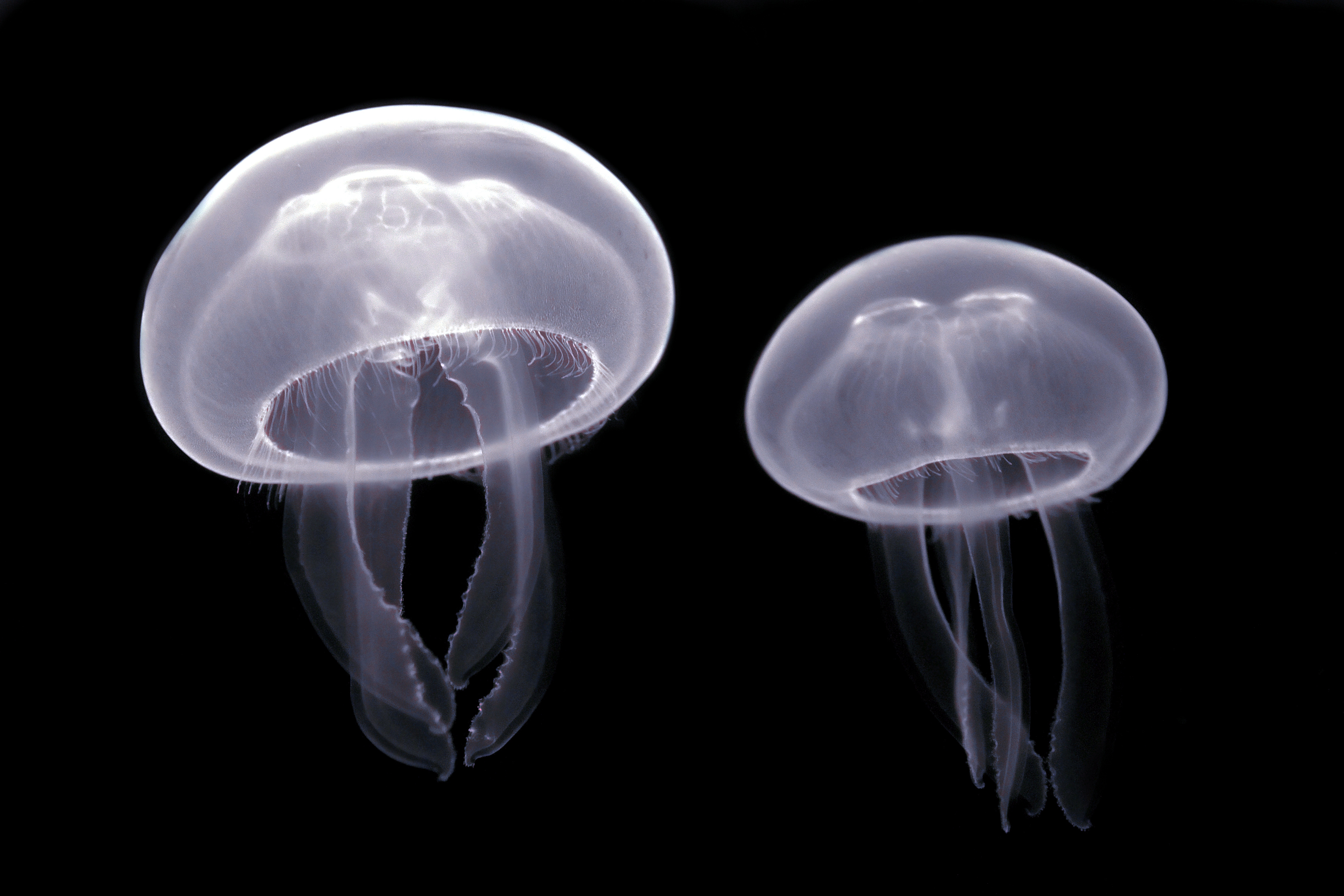
| Examples | Hydra, sea anemone (Adamsia), corals | Moon jelly (Aurelia), Obelia medusa |
In Obelia both forms share one life cycle: the sessile polyp colony buds off tiny medusae asexually from reproductive polyps (gonozooids); the medusae release gametes, and the fertilised egg develops through gastrulation into a ciliated planula larva that settles into a new polyp colony. This alternation of asexual polyp and sexual medusa generations is metagenesis — but it is not universal: Hydra never forms a medusa, and all Anthozoa are polyp-only.
The Four Living Classes of Cnidaria
| Class | Dominant body form | Distinguishing features | Example |
|---|---|---|---|
| Hydrozoa | Polyp dominant; medusa small or absent | Most varied; many colonial, polymorphic species; medusa usually with a velum | Hydra |
| Scyphozoa | Medusa dominant — the true jellyfish | Large bell, no velum; polyp reduced to a tiny scyphistoma producing ephyrae by strobilation | Aurelia (moon jelly) |
| Cubozoa | Medusa dominant | Cube-shaped bell; lensed eyes on the rhopalia; among the most venomous animals known | Chironex (sea wasp) |
| Anthozoa | Polyp only — no medusa stage | Solitary or colonial polyps; gastrovascular cavity partitioned by mesenteries; many secrete calcareous or horny skeletons | Sea anemone (Adamsia), corals |
Representative species:
- Hydrozoa
- Hydra — freshwater solitary polyp; buds asexually;
- Obelia — hydroid colony showing metagenesis;
- Physalia (Portuguese man o' war) — a floating siphonophore colony, not one jellyfish: a gas-filled float with specialised feeding, stinging and reproductive zooids beneath;
- Millepora (fire coral) — colonial, painfully stinging hydrozoan;
- Velella (by-the-wind sailor) — small floating colony.
- Scyphozoa
- Aurelia (moon jelly) — familiar coastal medusa;
- Cyanea (lion's mane) — among the largest jellyfish;
- Cassiopea (upside-down jellyfish) — rests bell-down on the seabed;
- Rhizostoma — barrel jellyfish.
- Cubozoa
- Chironex fleckeri (sea wasp) — dangerously venomous Indo-Pacific box jellyfish;
- Tripedalia cystophora — small box jellyfish with lensed eyes;
- Chiropsalmus — venomous Indo-Pacific box jellyfish.
- Anthozoa
- Adamsia — sea anemone, often on hermit-crab shells;
- Acropora (staghorn coral) — reef-building stony coral;
- Tubipora (organ-pipe coral) — tubular skeleton;
- Pennatula (sea pen), Gorgonia (sea fan) — colonial non-reef forms.

Ecological and Economic Importance
Coral reefs — built by colonial anthozoan polyps secreting calcium carbonate — are among the most productive marine biome ecosystems on Earth, supporting roughly a quarter of all marine species on less than 1% of the ocean floor. Medusae and polyps are also major zooplankton predators, channelling energy through marine food webs.
Cnidarian venoms are studied as sources of painkillers and other drugs, while reef fisheries and tourism add economic weight. The same venoms demand respect: stings from box jellyfish and the Portuguese man o' war can be medically serious.
Frequently Asked Questions
What are the defining characteristics of phylum Cnidaria?
Cnidarians are radially symmetrical, diploblastic animals with tissue-level organisation. Their defining feature is the cnidoblast, a stinging cell containing a nematocyst. They have a gastrovascular cavity with a single opening, a diffuse nerve net with no brain, and occur as polyps, medusae, or both.
What are cnidoblasts and what do they do?
Cnidoblasts (cnidocytes) are specialised stinging cells, concentrated on the tentacles, each housing a nematocyst. When the trigger-like cnidocil is touched, the nematocyst fires by a sudden rise in osmotic pressure — piercing prey and injecting venom, or ensnaring it. They serve in prey capture and defence, and occur in no other phylum.
How do a polyp and a medusa differ?
The polyp is cylindrical and sessile with the mouth facing upward, a thin mesoglea, and mainly asexual reproduction (e.g. Hydra, sea anemones). The medusa is bell-shaped and free-swimming with the mouth facing downward, a thick jelly-like mesoglea, and mainly sexual reproduction (e.g. jellyfish). They are two forms of the same basic body plan.
What is metagenesis in cnidarians?
Metagenesis is the alternation of the asexual polyp generation with the sexual medusa generation in one life cycle, as in Obelia: the polyp colony buds off medusae asexually, and the medusae produce gametes sexually. It is not universal — Hydra and all anthozoans (corals, sea anemones) never produce a medusa.
Is the Portuguese man-of-war a jellyfish?
No. The Portuguese man o' war (Physalia) is a floating colony of specialised polyps and medusae (a siphonophore of class Hydrozoa), not a single animal. A gas-filled float (pneumatophore) keeps it at the surface while long stinging zooids (dactylozooids) trail beneath to capture prey.
How do corals build reefs?
Reef-building corals are colonial anthozoan polyps that secrete calcium carbonate skeletons. Generation upon generation of polyps builds these skeletons into massive reefs over thousands of years — among the most productive and biodiverse ecosystems on Earth.
Practice MCQs
Q1. The diagnostic character of phylum Cnidaria is the presence of:
- Choanocytes
- Cnidoblasts
- Flame cells
- Nephridia
Answer: B — Cnidoblasts containing nematocysts are unique to Cnidaria; choanocytes belong to sponges and flame cells to flatworms.
Q2. Metagenesis (alternation of polyp and medusa generations) is shown by:
- Hydra
- Obelia
- Adamsia
- Corals
Answer: B — Obelia alternates between polyp and medusa generations; Hydra and the anthozoans (Adamsia, corals) never produce a medusa.
Q3. The gastrovascular cavity of cnidarians has:
- A mouth and a separate anus
- A single opening serving as both mouth and anus
- No opening at all
- Two mouths
Answer: B — There is a single opening: the mouth takes in food and expels undigested remains, so digestion is incomplete.
Q4. Which class of Cnidaria has no medusa stage?
- Hydrozoa
- Scyphozoa
- Anthozoa
- Cubozoa
Answer: C — Anthozoa (sea anemones, corals) exist only as polyps; the medusa stage is entirely absent.
Q5. The Portuguese man-of-war (Physalia) belongs to:
- Class Hydrozoa — it is a siphonophore colony
- Class Scyphozoa — it is a true jellyfish
- Class Anthozoa — it is a sea anemone
- Class Cubozoa — it is a box jellyfish
Answer: A — Physalia is a colonial hydrozoan (a siphonophore), not a single jellyfish; its sting comes from batteries of nematocysts on its trailing zooids.
Q6. Cnidarians are significant as the first phylum in the animal kingdom with:
- A brain
- A spinal cord
- Segmented nerve cords
- True nerve cells
Answer: D — Cnidarians have a diffuse nerve net with no brain, and they are the first phylum with true nerve cells.
Q7. Medusae swim by:
- Rhythmic contractions of the bell
- Ciliary gliding
- Waving of arms
- Beating of flagella
Answer: A — Medusae swim by rhythmic bell contractions (jet propulsion), while polyps are sessile.
Q8. The typical free-swimming larva of cnidarians is the:
- Trochophore
- Amphiblastula
- Planula
- Bipinnaria
Answer: C — The ciliated planula larva settles and develops into the polyp stage in most cnidarians.
Q9. Reef-building coral polyps construct their skeletons from:
- Silica
- Chitin
- Spongin fibres
- Calcium carbonate
Answer: D — Colonial anthozoan polyps secrete calcium carbonate skeletons that accumulate into coral reefs.
Q10. Which statement about cnidarians is FALSE?
- All cnidarians show metagenesis
- Polyps are sessile
- Medusae swim by bell contractions
- The nerve net has no brain
Answer: A — Not all cnidarians show metagenesis: Hydra and the whole of Anthozoa never produce a medusa.
Q11. Discharge of the nematocyst is driven by:
- A sudden rise in osmotic pressure inside the capsule
- Contraction of the mesoglea
- Beating of cilia on the tentacle
- Secretion of digestive enzymes
Answer: A — Stimulation of the cnidocil raises the capsule's internal osmotic pressure, everting the coiled thread explosively — among the fastest cellular processes known.
Q12. The highly venomous box jellyfish (sea wasp, Chironex) belongs to class:
- Hydrozoa
- Scyphozoa
- Cubozoa
- Anthozoa
Answer: C — Box jellyfish with cube-shaped bells and complex lensed eyes form the class Cubozoa; they include some of the most venomous marine animals known.
Short Questions
Q1. What are cnidoblasts, and why are they the diagnostic character of Cnidaria? See answer
A cnidoblast (cnidocyte) is a specialised stinging cell found in the tentacles and body wall of cnidarians. Each cnidoblast contains a nematocyst — a capsule holding a coiled, often barbed, hollow thread — and bears a hair-like trigger, the cnidocil, on its outer surface. When the cnidocil is touched, the capsule's internal osmotic pressure rises abruptly and the thread everts explosively, either piercing the target and injecting venom or ensnaring it.
Cnidoblasts are the diagnostic character of the phylum because no other animal group possesses them. The phylum's very name comes from the Greek knide (nettle), referring to these stinging cells. Whether the animal is a sessile polyp or a swimming medusa, a freshwater Hydra or a reef-building coral, the presence of cnidoblasts identifies it as a cnidarian at once.
Two distinctions are worth locking in. First, the cnidoblast is the cell while the nematocyst is the stinging organelle inside it — the terms are not interchangeable. Second, radial symmetry and the nerve net are shared with other groups, so they cannot diagnose the phylum; only the cnidoblast is exclusive to Cnidaria within the animal kingdom.
Q2. Differentiate a polyp from a medusa. See answer
The polyp is cylindrical and tube-like, sessile (attached to a surface), with the mouth facing upward and ringed by tentacles, and only a thin layer of mesoglea; it reproduces mainly asexually by budding. Examples include Hydra, the sea anemone Adamsia, and corals. The medusa is umbrella- or bell-shaped, free-swimming, with the mouth facing downward and tentacles on the bell margin, a thick jelly-like mesoglea, and mainly sexual reproduction by gametes — for example the moon jelly Aurelia.
Structurally the two forms are the same body plan reorganised: mouth orientation and mesoglea thickness are inverted, while tentacles, mouth and gastrovascular cavity are homologous. Medusae also carry more elaborate sense organs — rhopalia with statocysts for balance and ocelli for light detection, developed into true lensed eyes in box jellyfish — whereas polyps manage with simple sensory cells.
Many species show only one form: Hydra is polyp-only and some jellyfish are medusa-dominant. In Obelia both occur in a single life cycle — the polyp colony buds off medusae asexually and the medusae reproduce sexually (metagenesis). Note that members of radially symmetrical Anthozoa never produce a medusa at all.
Q3. What is metagenesis? Illustrate with the life cycle of Obelia. See answer
Metagenesis is the regular alternation of the asexual polyp generation with the sexual medusa generation within a single cnidarian life cycle. Unlike the alternation of generations in plants, both generations here are diploid — what alternates is the mode of reproduction (asexual versus sexual), not the ploidy.
The classic illustration is Obelia, a marine hydroid. Its branching polyp colony bears specialised reproductive polyps (gonozooids) that bud off tiny medusae asexually. The medusae swim away and release eggs and sperm; the fertilised egg develops through gastrulation into a ciliated planula larva, which settles on a surface and metamorphoses into the founding polyp of a new colony — completing the cycle.
Metagenesis must not be overgeneralised: it is absent wherever one body form is missing. Hydra reproduces entirely as a polyp, and the whole class Anthozoa (corals, sea anemones) has no medusa stage. When a medusa is present it is the sexual stage and the polyp the asexual one — a division of labour between a feeding, budding colony and a dispersing, gamete-producing swimmer.
Q4. Describe the four classes of Cnidaria, giving one distinguishing feature and one example of each. See answer
Hydrozoa is the most varied class: the polyp dominates, and where a medusa occurs it is small and usually bears a velum. Many hydrozoans are colonial and polymorphic — Hydra (freshwater polyp), Obelia, and Physalia, the Portuguese man o' war, which is a floating siphonophore colony rather than a single jellyfish.
Scyphozoa are the true jellyfish: the medusa dominates, with a large bell lacking a velum, while the polyp is reduced to a tiny scyphistoma that produces juvenile ephyrae by strobilation — for example Aurelia, the moon jelly. Cubozoa, the box jellyfish, also have a dominant medusa, but the bell is cube-shaped and the rhopalia carry complex lensed eyes; Chironex (sea wasp) is among the most venomous marine animals known.
Anthozoa — sea anemones, corals, sea pens — are polyp-only: no medusa is ever produced. Their gastrovascular cavity is partitioned by mesenteries, and many secrete calcareous or horny skeletons; reef-building corals such as Acropora construct entire reefs. The four classes are thus separated by which body form dominates and whether a medusa occurs at all — a pattern rooted in their diploblastic body plan.
Q5. Describe digestion in cnidarians. See answer
Digestion in cnidarians is two-stage. Prey captured by nematocyst-armed tentacles is drawn into the gastrovascular cavity (coelenteron), where gland cells of the gastrodermis secrete enzymes and food is digested extracellularly. The resulting small particles are then engulfed by gastrodermal cells and digestion is completed intracellularly. Because the cavity has a single opening, undigested remains are egested through the same mouth — an incomplete digestive system.
This dual mode reflects the cnidarians' position as early eumetazoans: extracellular digestion in a cavity is an advance over the purely intracellular digestion of sponges, but the single opening and absence of specialised digestive glands keep it primitive beside the complete gut tube of advanced bilaterians. The gastrovascular cavity also doubles as a hydrostatic skeleton and distribution system, compensating for the lack of circulatory organs.
The order matters: extracellular first, then intracellular — never intracellular alone. Nutrient-absorbing cells of the endoderm-derived gastrodermis complete the process, and the absence of a through-gut explains why waste must leave by the mouth.
Q6. Why are cnidarians ecologically and economically important? See answer
Ecologically, cnidarians are keystone organisms of the sea. Reef-building corals — colonial anthozoan polyps secreting calcium carbonate skeletons — construct coral reefs, among the most productive marine biome ecosystems on Earth: reefs support roughly a quarter of all marine species while covering less than 1% of the ocean floor. Medusae and polyps are also major predators of zooplankton, channelling energy through marine food webs.
Economically, reefs underpin fisheries and tourism worth billions of dollars, while cnidarian venoms — refined over hundreds of millions of years — are investigated as sources of painkillers and other drugs. The same venoms demand respect: stings from box jellyfish (Chironex) and the Portuguese man o' war (Physalia) can be medically serious.
The deeper significance is evolutionary: as the first animals with true tissues and nerve cells, cnidarians show how a simple diploblastic body plan, armed with the unique cnidoblast, could radiate into 11,000 species — from solitary freshwater polyps to ocean-spanning reef systems. Protecting reefs therefore protects both a living record of early animal evolution and the human economies built on it.
References
- OpenStax Biology 2e, 28.2: Phylum Cnidaria — symmetry, diploblastic organisation, cnidocytes and nematocysts. https://openstax.org/books/biology-2e/pages/28-2-phylum-cnidaria
- Animal Diversity Web: Cnidaria — organisation, polyp and medusa forms, planula larva. https://animaldiversity.org/accounts/Cnidaria/
- UCMP Berkeley: Introduction to the Cnidaria — classification and diversity. https://ucmp.berkeley.edu/cnidaria/
- NCBI Taxonomy Database: Cnidaria (Taxonomy ID 6073) — current classification. https://www.ncbi.nlm.nih.gov/Taxonomy/Browser/wwwtax.cgi?mode=Info&id=6073
- NOAA Ocean Service: What are corals? — reef-building and biodiversity. https://oceanservice.noaa.gov/facts/coral.html
Comments
Leave a comment