
Phylum Platyhelminthes: General Characters
Quick answer: Phylum Platyhelminthes, the flatworms, are soft-bodied, dorsoventrally flattened worms — planarians, flukes and tapeworms. They are triploblastic yet acoelomate, excrete through flame cells, and lack circulatory and respiratory systems. Most are hermaphroditic parasites with suckers and hooks; tapeworms have no gut at all and absorb food through the body surface.
Key Facts: Phylum Platyhelminthes
- Flatworms: about 29,000 described species of soft, unsegmented, dorsoventrally flattened worms — the largest phylum of acoelomate animals.
- Body plan: triploblastic but acoelomate — three germ layers, yet no body cavity; the interior is packed with parenchyma (mesenchyme).
- Symmetry and senses: bilateral symmetry with the first simple brain — cerebral ganglia joined to ladder-like longitudinal nerve cords.
- Excretion: by flame cells (protonephridia); no specialised circulatory or respiratory systems — exchange happens by diffusion.
- Four classes: Turbellaria (free-living planarians), Trematoda (flukes), Monogenea (fish ectoparasites) and Cestoda (tapeworms, with no gut).
- Well-known members: Planaria (regeneration), Fasciola hepatica (liver fluke), Schistosoma (blood fluke), Taenia solium (pork tapeworm).
Flatworms are among the most instructive animals in the animal kingdom classification. Phylum Platyhelminthes (Greek platys, flat + helmins, worm) gathers soft-bodied, dorsoventrally flattened worms — from harmless freshwater planarians to the flukes and tapeworms that parasitise humans and livestock. The phylum shows the triploblastic organisation (three germ layers) in its simplest form: ectoderm, mesoderm and endoderm are all present, yet no coelom ever develops. With bilateral symmetry, the first brain and flame-cell excretion, flatworms mark a pivotal grade between the diploblastic cnidarians and the coelomate worms.
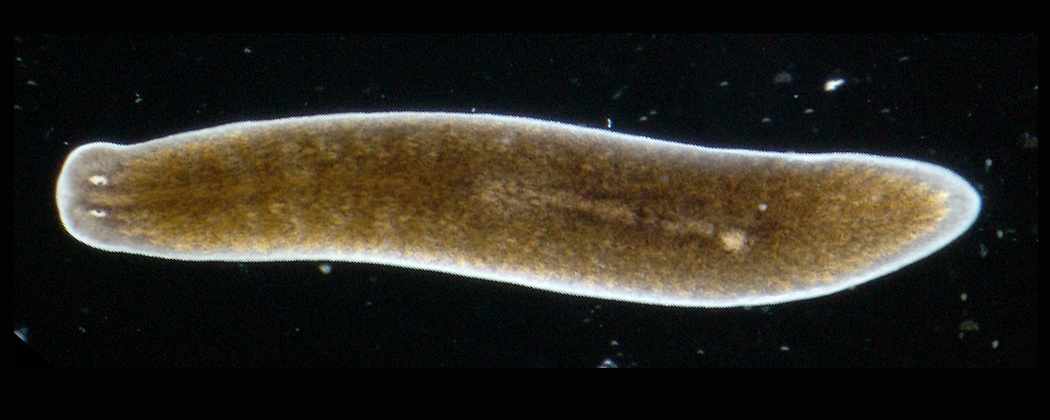

General Characters of Phylum Platyhelminthes
- Body form: soft, unsegmented, dorsoventrally flattened; bilateral symmetry with distinct head and tail ends — the first clear cephalization.
- Germ layers and cavity: triploblastic (ectoderm, mesoderm, endoderm) yet acoelomate — no body cavity forms; the space between body wall and gut stays packed with parenchyma (mesenchyme). See acoelomate vs pseudocoelomate vs coelomate.
- Size range: from microscopic species to tapeworms several metres long.
- Digestive system: incomplete in most — a mouth with a muscular, often eversible pharynx leads to a branched intestine; waste is egested through the same opening. Cestodes have no gut at all and absorb dissolved nutrients through the tegument.
- Excretion: protonephridia ending in flame cells, which drive fluid to pores (nephridiopores); their chief task is osmoregulation — expelling excess water.
- Circulation and respiration: no specialised systems; oxygen, carbon dioxide and nutrients move by diffusion through the body surface — the functional reason for the flattened shape.
- Nervous system: ladder-like — a pair of cerebral ganglia (a simple brain) at the head, joined to two longitudinal nerve cords linked by transverse commissures; pigment-cup ocelli detect light direction.
- Reproduction: mostly hermaphroditic with internal fertilisation (schistosomes are the dioecious exception); parasites have complex indirect life cycles, while free-living forms reproduce asexually by fission and regenerate using neoblast stem cells.
- Habitat: marine, freshwater and damp terrestrial habitats; many parasitise vertebrates and invertebrates.
The Four Classes of Platyhelminthes
| Class | Lifestyle | Key features | Examples |
|---|---|---|---|
| Turbellaria | Mostly free-living (marine, freshwater, damp land) | Ciliated epidermis, eversible pharynx, eyespots, remarkable regeneration | Planaria torva, Dugesia spp. |
| Trematoda | Endoparasitic flukes | Leaf-shaped body, oral and ventral suckers, syncytial tegument, complex life cycles with snail hosts | Fasciola hepatica, Schistosoma spp. |
| Monogenea | Ectoparasites, mostly of fish | Posterior haptor with hooks, direct single-host life cycle | Gyrodactylus spp., Dactylogyrus spp. |
| Cestoda | Endoparasitic tapeworms | Scolex with suckers and hooks, strobila of proglottids, no digestive system | Taenia solium, Echinococcus granulosus |
Note: molecular phylogeny shows Turbellaria is paraphyletic — the parasitic classes evolved from within it — but the four-class scheme remains the standard teaching classification.
Representative Species and Their Hosts
- Turbellaria — free-living flatworms
- Planaria torva — ponds and slow streams of Europe; a predator of snails and small invertebrates.
- Dugesia spp. — freshwater planarians found worldwide; classic laboratory models of regeneration.
- Schmidtea mediterranea — Mediterranean freshwater triclad; a leading model organism for stem-cell and regeneration research.
- Trematoda — endoparasitic flukes
- Fasciola hepatica (liver fluke) — bile ducts of sheep, cattle and humans; freshwater snails as intermediate hosts.
- Schistosoma mansoni (blood fluke) — blood vessels of humans; freshwater snails as intermediate hosts.
- Clonorchis sinensis (Chinese liver fluke) — bile ducts of humans and fish-eating mammals; snails, then freshwater fish, as intermediate hosts.
- Monogenea — ectoparasites of aquatic animals
- Gyrodactylus spp. — skin and gills of fish; direct life cycle with no intermediate host.
- Dactylogyrus spp. — gills of freshwater fish; single-host life cycle.
- Cestoda — tapeworms
- Taenia solium (pork tapeworm) — small intestine of humans; pigs carry the bladder-worm (cysticercus) larvae.
- Taenia saginata (beef tapeworm) — small intestine of humans; cattle carry the larvae.
- Echinococcus granulosus (hydatid worm) — intestine of dogs; hydatid cysts develop in sheep, cattle and humans.


What Are Flame Cells?
Flame cells are the blind terminal cells of the flatworm excretory system. Each bears a tuft of cilia whose rhythmic beating looks like a flickering flame. The beating drives water and dissolved wastes from the parenchyma into the protonephridia — a tubule network releasing fluid through nephridiopores.
Their principal role is osmoregulation: freshwater flatworms constantly gain water by osmosis and must pump the excess out. Nitrogenous wastes leave by the same route. With no kidneys, blood vessels or gills, this ciliary pump is their entire waste-disposal system — and the diagnostic excretory character of the phylum.
Parasitic Adaptations of Flatworms
Three of the four classes are wholly parasitic, showing the classic signatures of the parasitic lifestyle (see parasitic adaptations in helminths):
- Attachment organs: muscular suckers in flukes, the hooked, sucker-bearing scolex of tapeworms, and the hook-armed haptor of monogeneans grip host tissue.
- Protective tegument: a tough syncytial covering resists host digestive enzymes and immune attack; in cestodes it is also the absorptive surface replacing the gut.
- Enormous fecundity: a single tapeworm sheds vast numbers of eggs, each proglottid an independent hermaphroditic unit — sheer numbers beat the tiny odds of reaching a new host.
- Reduction of unnecessary organs: tapeworms have lost the digestive system entirely; sense organs and locomotory structures are reduced.
- Complex life cycles: indirect cycles exploit intermediate hosts (Fasciola: snail → sheep/cattle; Taenia: pig/cattle → humans), multiplying transmission chances.
- Anaerobic metabolism: gut dwellers generate energy without oxygen, suiting the oxygen-poor intestine.
Flatworms and Human Health
Several flatworms are significant pathogens. Taenia solium causes taeniasis, and its larvae cause cysticercosis when humans ingest the eggs. Schistosoma species cause schistosomiasis (bilharzia), afflicting more than 200 million people in the tropics. Fasciola hepatica damages the livers of livestock and occasionally humans, while Echinococcus hydatid cysts can grow in human organs for years. Control rests on one foundation: understanding each parasite's life cycle and breaking it through sanitation, meat inspection and snail control.
Conclusion
Platyhelminthes compresses an extraordinary story into a flat, acoelomate body: the simplest triploblastic organisation, the first brain, flame-cell excretion, and — in parasites — extreme specialisations from the tapeworm's lost gut to its staggering egg output. From regenerating Planaria to medically important flukes and tapeworms, flatworms show that success needs no coelom or circulatory system — only solutions that work.
Frequently Asked Questions
What are the general characters of phylum Platyhelminthes?
Flatworms are bilaterally symmetrical, triploblastic, acoelomate worms with dorsoventrally flattened, unsegmented bodies. They have an incomplete gut (absent in tapeworms), excrete through flame cells, lack circulatory and respiratory systems, show the first simple brain with a ladder-like nervous system, and are mostly hermaphroditic.
Why are flatworms called acoelomates if they are triploblastic?
Although flatworms possess mesoderm (triploblastic), no cavity ever hollows out within it — the space between the body wall and the gut remains filled with solid parenchyma. Triploblastic counts germ layers; acoelomate describes the absence of a cavity. The two terms are independent.
What are flame cells and what is their function?
Flame cells are ciliated terminal cells of the protonephridial excretory system. Their beating cilia drive fluid into excretory tubules that open through nephridiopores. They mainly expel excess water (osmoregulation) along with nitrogenous wastes, and are the diagnostic excretory structure of Platyhelminthes.
Why don't tapeworms have a digestive system?
Tapeworms live in the host's intestine surrounded by already-digested food, which they absorb directly through their tegument (body surface) — so a mouth and gut would be redundant. The gut was lost through parasitic reduction, freeing resources for attachment and massive egg production.
What are the four classes of Platyhelminthes? Give one example of each.
Turbellaria — Planaria (free-living); Trematoda — Fasciola hepatica (liver fluke); Monogenea — Gyrodactylus (fish gill parasite); Cestoda — Taenia solium (pork tapeworm).
Which flatworms infect humans, and how do people get them?
Taenia solium and T. saginata come from undercooked pork or beef carrying larval cysts; Schistosoma larvae penetrate the skin in contaminated fresh water; Fasciola is picked up from water plants carrying encysted larvae. Sanitation, meat inspection and avoiding contaminated water break these cycles.
Practice MCQs
Q1. Platyhelminthes are best described as:
- Diploblastic and acoelomate
- Triploblastic and acoelomate
- Triploblastic and coelomate
- Diploblastic and pseudocoelomate
Answer: B — Flatworms possess all three germ layers but no body cavity ever develops; the interior stays packed with parenchyma.
Q2. Flame cells are the terminal cells of:
- Metanephridia
- Protonephridia
- Malpighian tubules
- Green glands
Answer: B — Protonephridia are the blind-ended excretory tubules of flatworms, each ending in a flame cell; metanephridia belong to annelids.
Q3. Which flatworm has no digestive system at all?
- Planaria
- Fasciola
- Taenia
- Schistosoma
Answer: C — Tapeworms (Taenia) absorb already-digested food through the tegument and have lost the gut entirely; the others have an incomplete gut.
Q4. The nervous system of flatworms is:
- A diffuse nerve net
- Ladder-like, with cerebral ganglia and longitudinal cords
- A dorsal hollow nerve cord
- A single ventral cord with segmental ganglia
Answer: B — A pair of cerebral ganglia (simple brain) with two longitudinal cords joined by transverse commissures; the diffuse nerve net is the cnidarian condition.
Q5. Unlike most flatworms, Schistosoma species are:
- Hermaphrodite like other flukes
- Dioecious, with separate male and female individuals
- Lacking a nervous system
- Free-living filter feeders
Answer: B — Schistosomes are the famous dioecious exception among the otherwise hermaphroditic flatworms.
Q6. Monogeneans differ from digenean trematodes in that monogeneans:
- Use two intermediate hosts
- Complete the life cycle on a single host, usually a fish
- Are free-living predators
- Lack attachment organs
Answer: B — Monogeneans have a direct, single-host life cycle as ectoparasites of fish, gripping the host with a hooked haptor.
Q7. The flatworm renowned for regenerating a complete body from a small fragment is:
- Planaria
- Taenia
- Fasciola
- Echinococcus
Answer: A — Planarians regenerate using abundant adult stem cells called neoblasts.
Q8. In the life cycle of Fasciola hepatica, the intermediate host is a:
- Pig
- Mosquito
- Snail
- Human
Answer: C — The liver fluke's larval stages develop in freshwater snails before encysting for ingestion by sheep, cattle or humans.
Q9. A tapeworm obtains its nutrition by:
- Ingesting host tissue with a muscular pharynx
- Absorbing dissolved nutrients through the tegument
- Filter-feeding with cilia
- Photosynthesis via symbiotic algae
Answer: B — With no gut, cestodes absorb pre-digested nutrients directly across the syncytial tegument.
Q10. The flickering "flame" of a flame cell is produced by:
- A tuft of beating cilia
- Bioluminescence
- Burning waste products
- Contracting muscle fibres
Answer: A — Each flame cell bears a tuft of cilia whose rhythmic beating resembles a tiny flame under the microscope.
Q11. Each repeating unit of a tapeworm strobila, containing a complete set of male and female reproductive organs, is called a:
- Metamere
- Proglottid
- Scolex
- Somite
Answer: B — The strobila is a chain of proglottids budded from the neck region; this is strobilization, not true metamerism.
Q12. Which of the following is NOT a parasitic adaptation of flatworms?
- Suckers and hooks for attachment
- A tough syncytial tegument
- Massive egg production
- A spacious coelom housing complex organs
Answer: D — Flatworms are acoelomate and have no coelom at all; the other three are classic parasitic adaptations.
Short Questions
Q1. Why are flatworms called acoelomate although they are triploblastic? See answer
Flatworms are triploblastic — ectoderm, mesoderm and endoderm are all present (see diploblastic vs triploblastic organisation) — yet they are acoelomate because no body cavity ever hollows out within the mesoderm. The space between the body wall and the gut remains filled with solid, loosely packed tissue called parenchyma (mesenchyme), so there is simply no cavity to name (see coelom: acoelomate vs pseudocoelomate vs coelomate).
The two terms describe different things, which is why the combination surprises students. Triploblastic counts germ layers; acoelomate describes the absence of a cavity. Possessing mesoderm is necessary but not sufficient for a coelom: the cavity must actually open up within the mesoderm, which first happens in the annelids. Flatworms therefore display the triploblastic plan in its simplest possible form.
Remember the chain: three germ layers → parenchyma-filled interior → no coelom. Any statement pairing Platyhelminthes with "coelomate" or "diploblastic" fails on this point, and the distinction between counting layers and describing cavities resolves the apparent contradiction.
Q2. Describe the structure and function of flame cells. See answer
Flame cells are the blind, terminal cells of the flatworm excretory system. Each flame cell bears a tuft of cilia whose rhythmic flickering looks like a tiny flame under the microscope — hence the name. The beating cilia drive water and dissolved wastes from the surrounding parenchyma into a network of excretory tubules called protonephridia, which carry the fluid to the body surface and release it through pores called nephridiopores.
Their principal function is osmoregulation: freshwater flatworms constantly gain water by osmosis and must pump the excess out to keep their body fluids at a stable concentration. Nitrogenous wastes leave by the same route. Because flatworms have no kidneys, blood vessels or gills, this simple ciliary pump is their entire solution to water and waste balance.
Flame cells are the diagnostic excretory structure of Platyhelminthes — no other phylum has them. Contrast them with the metanephridia of annelids, which are open-ended tubules draining the coelom: protonephridia are blind-ended, metanephridia are open at both ends.
Q3. Why have tapeworms lost the digestive system? See answer
Tapeworms (class Cestoda, e.g. Taenia solium) live in the small intestine of their host, permanently bathed in already-digested food.
They absorb dissolved nutrients — sugars, amino acids — directly across the tegument (body surface), so a mouth, gut and anus would be redundant machinery. Evolution has stripped the system away entirely.This is a textbook case of parasitic reduction: structures the free-living ancestor needed become a costly burden inside a host. The resources saved go into what matters for a parasite — attachment (the scolex armed with hooks and suckers) and reproduction (a ribbon of proglottids shedding vast numbers of eggs). Other flatworms kept a gut: planarians and flukes have a branched, incomplete digestive system with a single opening.
The principle behind the answer is worth stating explicitly: parasites tend to surrender every structure the host provides for them and invest everything in transmission — the central theme of parasitic adaptations in helminths. "No gut because the host digests the food" captures the whole logic in one line.
Q4. Name the four classes of Platyhelminthes with one example of each. See answer
The four classes are: Turbellaria — mostly free-living, with a ciliated epidermis and remarkable regenerative power (example: Planaria torva); Trematoda — endoparasitic flukes with leaf-like bodies and suckers (example: Fasciola hepatica, the liver fluke); Monogenea — ectoparasites of fish with a hooked posterior haptor and a direct, single-host life cycle (example: Gyrodactylus spp.); and Cestoda — tapeworms with a hooked scolex, a strobila of proglottids and no gut (example: Taenia solium, the pork tapeworm).
The classes divide cleanly by lifestyle. Turbellaria stayed free-living, while Trematoda, Monogenea and Cestoda became parasites, evolving suckers, hooks, tough teguments and — in flukes and tapeworms — complex multi-host life cycles. Note the reproductive twist: most flatworms are hermaphroditic, but Schistosoma (a trematode) is famously dioecious, with separate sexes.
A compact memory aid: ciliated free-living flatworm → Turbellaria (Planaria); leaf-like sucker-bearing fluke → Trematoda (Fasciola); single-host fish ectoparasite with haptor → Monogenea (Gyrodactylus); ribbon of proglottids with no gut → Cestoda (Taenia).
Q5. Describe the nervous system of flatworms. Why is it called the first cephalization? See answer
Flatworms have a ladder-like nervous system: a pair of cerebral ganglia (a simple brain) at the head end, joined to two longitudinal nerve cords that run the length of the body and are linked by transverse commissures — like the rungs of a ladder. Pigment-cup ocelli detect light direction, and chemoreceptive pits sample the surroundings. This is a major advance over the diffuse nerve net of cnidarians, which has no brain at all.
It is called the first cephalization because flatworms are the first animals in which nerve cells concentrate into a brain at the anterior end. Cephalization is tied to bilateral symmetry and active, head-first movement: the end that meets the environment first carries both the sensors and the processing centre.
From this flatworm starting point, cephalization intensifies through the animal kingdom toward the elaborate brains of arthropods and vertebrates. The sequence to hold in mind: nerve net without a brain (Cnidaria) → first brain, ladder-like system (Platyhelminthes) → increasingly centralised brains in the coelomate phyla.
Q6. List the main parasitic adaptations of flatworms. See answer
Three classic parasitic adaptations of flatworms are: (1) attachment organs — suckers in flukes, the tapeworm's hooked and sucker-bearing scolex — which grip host tissue against dislodgement; (2) a tough syncytial tegument that resists the host's digestive enzymes and immune attack; and (3) enormous fecundity — a single tapeworm sheds vast numbers of eggs, beating the tiny odds of any one egg reaching a new host.
Further adaptations complete the picture: loss of unnecessary organs (tapeworms abandoned the digestive system entirely), complex indirect life cycles exploiting intermediate hosts (Fasciola: snail → sheep/cattle; Taenia: pig/cattle → humans), and anaerobic metabolism suited to the oxygen-poor gut. Together they show the parasite's bargain — surrender independence, maximise transmission.
Each adaptation pairs with its purpose: attachment → staying put; tegument → surviving digestion; high egg output → completing transmission. For the full account of how these strategies evolved across parasitic worms, see parasitic adaptations in helminths.
References
- OpenStax, Concepts of Biology — §15.3 Flatworms, Nematodes, and Arthropods: the traditional four-class scheme (Turbellaria, Monogenea, Trematoda, Cestoda) and flatworm diversity. https://openstax.org/books/concepts-biology/pages/15-3-flatworms-nematodes-and-arthropods
- Animal Diversity Web — Platyhelminthes: classification, morphology and natural history. https://animaldiversity.org/accounts/Platyhelminthes/
- Wikipedia — Flatworm: distinguishing features, flame-cell protonephridia, and the major subgroups. https://en.wikipedia.org/wiki/Flatworm
- NCBI Taxonomy Database — Platyhelminthes classification. https://www.ncbi.nlm.nih.gov/Taxonomy/Browser/wwwtax.cgi?mode=Info&id=6157
- University of Edinburgh, Natural History Collections — Platyhelminthes: the four classes of acoelomate flatworms and hermaphroditism. http://www.nhc.ed.ac.uk/index.php?page=24.25.333.375
Comments
Leave a comment